Search This Blog

Saturday, October 29, 2011

Mind your manners tethering

Naughty Bella is counter cruising!

Mind your manners tethering
It is interesting how one training problem can actually be related to another.  For example, last week a n puppy parent commented that were having  a little difficulty with house training.  The pup could hold it  but occasionally would have accidents.  No one wants to battle house soiling, so I pressed for more details.  As we discussed the whole scenario of accidents, it turns out the puppy was highly active, getting into trouble and would then eliminate.  Wisely, the family did not want to use the crate for a punishment or isolation area and was not sure what to do.  All the highly active "naughty" play that is typical for a pup was difficult to find a solution for.   Getting the history of what a puppy is doing wrong is extremely important to help that family get on the right track, and that puppy to learn good manners in a positive way.   
Typically in a scenario like this I would suggest a baby gate to keep the puppy in the room you are in.  What is difficult is that many homes now have a large open floor plan so a baby gate won't work.  There are some pet gate models that expand up to 72" wide, but  that may not solve the problem in some homes.  So how does one keep a puppy out of trouble? 
The answer is a tether.  A tether is a leash or two joined to give a puppy about 10 feet  to play, chew on toys, and  a bed to rest on.  Tie  the tether to the leg of a strong chair, table or put a screw eye in the wall for attachment.  The tether is enforcing that this puppy has to stay in the area the owner is in, and prevents the pup from chewing on cords, furniture or going to an accident area. 
Yummy plastic peanut butter jar for tether time!
  Even if the puppy is not  happy on the tether, they will settle down and accept it after they see they are not going to be released.  Now when the puppy is settled,   praise the puppy and give an occasional treat.  This teaches the puppy to settle down on the bed when you are not able to play with them.  When you can play and give them attention, they are off the tether and played with continuously for at least 15 minutes to wear them out.  Off the tether means fun, games and activity ; on the tether means quiet time.  The crate can also be used for quiet time, but if your puppy is in the crate for more than 10 hours a day, they need to have more time in other areas of the home.
Bella is tethered for a moment so Butter can be leashed in peace 

Some people may think a tether looks mean or that the pup will think they are being punished.  When you give a reward like a food toy when they are tethered, the effect  is  the opposite.  The tether means good things are coming and the pup wants to stay put to get them.  Do not release your pup from the tether if they are barking or pulling unless you are suspicious that they need to go out.  If so, take them directly outside and praise them.  If they have not eliminated, do not take them off the tether.  Otherwise they will learn to bark to get off the tether!


I still need to use the tether on Bella our family dog who will be 3 soon.  She gets a wild hair to start pulling things off the shelf when she wants to have extra attention.  She will come to the tether ( yes a little reluctantly)when I call her and get content on her bed with a stuffed Kong.  For her it is almost as if she needs to be tethered to settle herself.  She is a very active dog and it is hard for her to self settle at times.  The tether is her friend, and she knows it.  She gets to lay close by as I am working on the computer, or enjoying TV time with my family.  She is still loved and now knows she cannot just demand attention all the time.
Looking pitiful at the kitchen table, but it beats counter cruising

So use a tether to teach good manners and calm settling.  It is a great alternative to constant crating, especially if you have a large open floor plan.  Make it happy with a nice bed to lay on and some rewarding toy or treat.   Use this technique as your pet grows up to remind them of good settling manners.
For more information on pet behavior and positive handling go to www.drsallyjfoote.com


Wednesday, September 28, 2011

How far is too far to walk?

walking in the parade

How far is too far to walk?
After the home coming parade last Friday, someone asked about how Butterscotch did after the walk.  Was he used to walking that far (he is. He walks that far twice daily).  The next question was how far was too far to walk an old dog.   No one wants to over work their pet, especially an older one.  How does one know what is a good amount of exercise but not too much to cause harm?
The answer will depend on your pet's fitness level now, if there is any arthritis already present and what kind of surface your pet will be walking or exercising on.  All pets, especially older ones get a lot of help by regular daily walking.  So, even a short walk will be good for your pet.  Walking helps the circulation to the heart, liver and kidneys helping those important organs to work better.  It is really stimulating to the brains of older pets to sniff out different things and see different sights on a walk.  Keeping muscles fit is one of the best ways to reduce pain and stiffness due to arthritis.
Butterscotch on his am route
So,  for a first walk, notice when your dog starts to tire out make note of how far or how long you have walked.  Take about 5 minutes to let the dog lay and rest before heading home ( be patient! ).  Now, for future walks go half the distance out that you went when they became tired so you can do the whole route in 1 walk.  Use this as a starting point.  Repeat this walk twice daily.  Even if it is just 5 minutes of walking, 2 walks that are 5 minutes and not over tiring a dog is better than 1 10 minute walk.  Every week you can increase the walk by 2 minutes or so.   The point is to keep up the daily walks  so your dog does not loose it's conditioning.  

Grass is a good surface to walk on.  The key is to praise your dog when walking with the head up and not buried in the grass.  Do not use a choke chain or prong collar.  These can be damaging to the neck.  The easy walk harness by Premier is a good choice to prevent pulling or guide the dog into you.  Older dogs do ok on pavement as long as it is not too hot, and they keep the pace at a walk.  Be mindful of areas where there may be broken glass, or other debris. 
As dogs get older they may not be able to hear as well.  So people may startle them, or shrill noises may upset them.  Pet them and use food rewards for walking well or encourage calm behavior when a train passes or emergency vehicle. 
Most dogs do best walking after they have been up for a little while to get their legs limber.  If your pet takes arthritis medication wait about 30 minutes or so before a long walk so the medication is already working.
Butterscotch is all ready for the parade with Ranger in the float
Walking your old dog is a great way to enjoy time together, keep them and yourself healthy, and show off your super senior dog! 
     Dr. Sally J Foote

Thursday, September 1, 2011

feline friendly vet exams

Ranger and Mercy chilling out
The word is out - cats outnumber dogs as pets in the home.  Yes, there are more cats as pets in the USA than dogs.  81.7 million cats to 72 million dogs according to the CATalyst council to be exact. Despite this, veterinarians are seeing fewer cats for regular care compared to dogs.  Various surveys have listed the reasons  and I am going to focus on one - many cats hate going to the veterinarian. Surprise!!!  Are you surprised? I am not.  The typical veterinary process  is not very cat friendly.  Good news is that things are changing at progressive veterinary clinics and there are things you can do to help your cat be more tolerant ( even like) check ups.
Liver paste by Kong in a syringe to reward
I have seen many cats become more tolerant and even like their exams as we use rewarding and less stressful handling my office, Okaw Veterinary Clinic.  What is less stressful handling?  First of all - minimal handling of the cat.  It shocks many owners to see my Certified Veterinary Technicians only rubbing the head of a kitty as I give vaccinations or injections.  Even more awesome is when a cat likes the liver paste fed by syringe, then give the injection as they are chowing down.  This reward is now linked with what used to be really upsetting.  I won't lie - there is a bit of pain with the injection but we use small 25ga needles, not the larger type typically used.  The pain is less noticeable due to the pleasure of the liver paste. So the liver paste wins out for the cat's attention.  Wouldn't you tolerate a blood draw better if you were able to eat a chocolate brownie as the needle went in?    So rubbing the head, sliding the body, feeding what ever this cat likes  during  examination  helps the cat link something good with the exam. The cat learns there are good things at the vet.

Leeza helps veterinary students learn 

For the hissing, hiding fearful cat, less stressful exams means being creative.  It also means telling clients how we are going to handle this kitty  differently than before and how it may help their cat. Some of what we do may  look a little crazy, but it works.  Taking the carrier apart and examining the cat while still in the base of the carrier is one way to make the exam a bit more tolerable.  The cat is surrounded by the smells it knows, and feels more protected.  I use a tongue depressor to examine the mouth so I will not be bitten and often put some salmon paste on it to make the depressor nice for the cat.  Covering the cat with a towel can work - some like the whole body covered some like the head only.  The point is to prevent the cat from escalating in hissing, jumping around, and resisting exam. It may seem contrary, but for cats  more hands means more fighting. 

examining the mouth using the tongue depressor
How the cat feels during the exam is what the cat will remember about everything involved in getting to the veterinarian.  So, the car ride, carrier, waiting area, exam room, table and hands of the assistants and veterinarian can be good, bad or neutral. Unfortunately, the majority of training how to restrain cats for exams has been based on holding them down.Cats really do not like to be held down.    This has resulted in many cats having a bad vet experience - hence the results of the study! When you are going to bring your cat in for an exam ask the staff at the clinic what types of handling do they use.  Low stess handling is a new "buzz word"  thanks to the book and writings of Dr. Sophia Yin, veterinarian and behaviorist.  If you do not hear those words, or descriptions of " we use blankets, Feliway ( Ceva inc) and other things to make the exam more cat friendly"  then look around.  These newer techniques are not a secret.  Practices are using them and the cat owner needs to help promote this in our profession by asking for it and selecting clinics that use less stressful techniques.

Use rewards at home when loading your cat into the carrier.   The Bella Behavior System for the pet owner will teach you how to offer and know what works for your cat to accept treatment and handling better. The kit has an instructional booklet, pet chart to record what works for your pet, and online support  It is available for purchase at www.drsallyjfoote.com

this kitty relaxes with her Feliway bandana
Now some cats are difficult to get in the carrier or even into the vet. You can ask your veterinarian if they will do a house call. It is still important that less stressful handling is used at the home exam a well.    Read my "Here Kitty Kitty" article at www.drsallyjfoote.com, and look for next month's blog about how to get your cat to the veterinarian easier.  Let me know what works or does not work for your cat.  We are all in this together to help our pets and us live longer happier lives together. . 


Monday, August 15, 2011

social networking in puppies


Butter came well socialized to people like my niece Carole who he hardly knew
I never really knew how important it was to get a young puppy out and about meeting and greeting  before the age of 16 weeks until I studied animal behavior.  Unfortunately, past teachings in veterinary medicine emphasised the need to keep a pup away from others until all the vaccinations were finished.  This prevented a puppy from having a chance to experience all the great things in the wide wide world during the open learning period between 6 to 14 weeks ( approx).  After 16 weeks, puppies enter a fear period where they are often timid of many things.  Waiting to get this pup out and about   makes it more difficult for this pup to learn fun things.  They can still learn, but they now have to get over an initial timidness then accept treats or rewards.  I was pretty lucky that I could take my dog to work. Walking them to work at 8 weeks, they were seeing cars, trains, bikes and other people.  I was socializing them without really  knowing it.  

Cooper and Daisy get to meet each other
two older puppies - the solid black is a bit timid
Take your pup to a puppy class that is focused on  learning to play nice with other dogs, meet and greet people and how to not be afraid of  loud noises.  We have these classes at Okaw Veterinary Clinic whenever we can gather a couple of puppies together. The focus of a puppy class is to learn how to be calmly curious and happy to see new things. We also teach the first commands of come and sit. There is also some time spent answering questions on house training, accepting grooming or other new puppy concerns.  The puppy classes are not about obedience, but about being a calm, well socialized dog.  The dogs that miss these classes often have problems later in life with fear of strangers, loud noises, or riding in the car.  They did not get that exposure as a young happy pup. They can learn as an older dog but it is often perplexing to the owner why this cute puppy backs away from friends and family.  If you have an older puppy, still take them to a class.  Don't be surprised if they may be the more shy one.  They can learn to open up and it will save a lot of problems.

pass the puppy helps with meeting unknown people
Think of holding back on socializing your puppy like holding a young child back from the playground  or preschool.  Like children, our puppies need to get out and socialize.  Lack of knowing all the good and scary things that life can offer makes for a very timid dog.  From this fear, aggression can unfold.  Then the aggressive dog is often given up to a shelter or worse, euthanized.  Socializing a puppy is a life saver.  If you are getting a puppy the 3 things  I feel are most important are supervised playtime with other pups, handling by and meeting unknown people, and lots of fun around loud noises.  Ask who ever is leading the class exactly what will be done.  If these components are not included keep looking. 


Mercy and Toby social networking


Thursday, July 7, 2011

Fighting Felines - Helping Mercy and Ranger get along

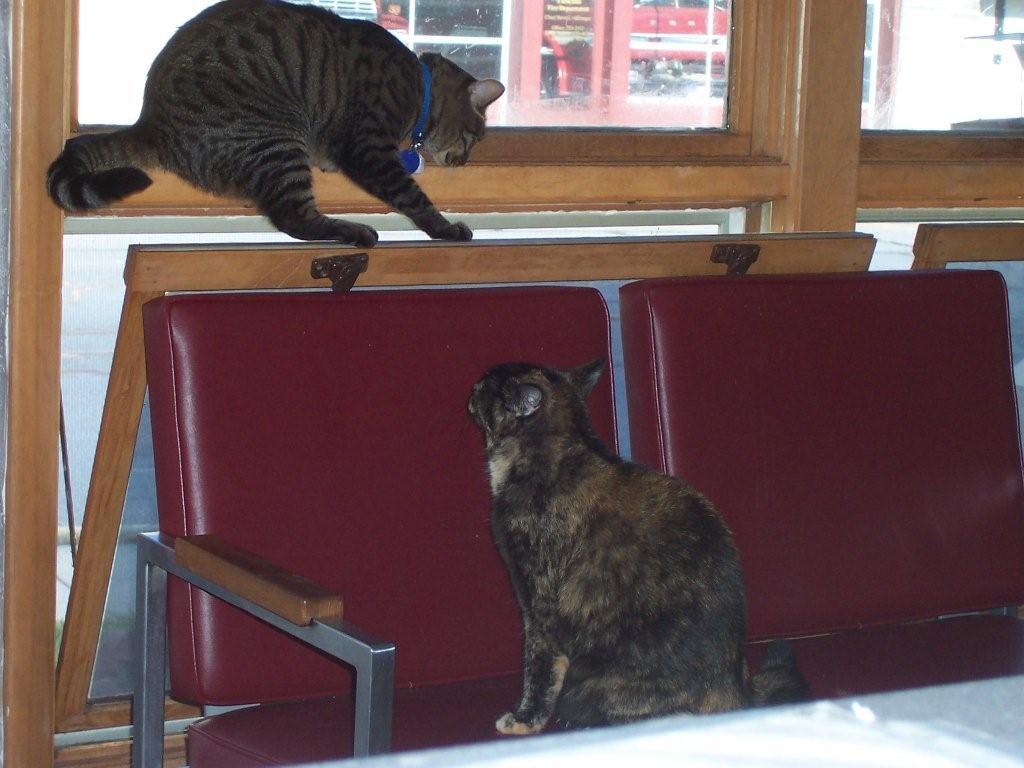
Over the past week or so, Ranger and Mercy have been at odds with each other in the mornings.  It would be hard to tell who was starting things - Mercy or Ranger.  We would suddenly hear the 'aurggggg" sound of Mercy as she was staring at  Ranger who would mindlessly pounce on her in a playful way.  This was not what Mercy wanted - she would then roll him over and the two would wrestle in a sort of confused play fight.  Usually tossing the tube toy would get Ranger to redirect, but not now.  Actually Mercy seemed to be starting it.  What is going on? 

Lots of clients deal with this very same scene at home.  These 2 cats get along much of the time, they actually do groom each other and the outbreaks were not daily.  Aggravating especially since these 2 cats live at an animal hospital that promotes good behavior!  How embarrassing to say the least.  I decided to treat my staff and the cats like a case.  Let's document what is happening, what does help to decrease the fighting and observe both Mercy and Ranger for what is triggering the events.  At first you think you know what is happening, but as we took a closer look we found out a few things.


Ranger ready for the day all dressed up
These are the facts we already knew.  The skirmishes were typically in the morning shortly after Ranger and Mercy were allowed free access to the clinic. The fights were in the waiting room area when no clients were there. Putting a baby T shirt on Ranger helped  him to be less of an agitator.  Now he loves to dress up, but it somehow it was helping him to ignore her threats.  I surmised that Mercy may want to have more range for facial rubbing of the clinic.  As she has aged she does not get up on all the counters for rubbing and perching like she used to.  So  now Mercy could be free in the whole clinic while Ranger was still confined ( he still gets into things).  Ranger would get dressed up each am before he had free range with Mercy.  Rachael made up an incident sheet to record where - when - who and what started it. 

Mercy's favorite spot
We discovered a few things!  Mercy was picking on Ranger most of the time. It just looked like he was the bad guy because she was vocal and he would be more physical.  On closer look he  was pouncing back in play not aggression.  She would stare him down as he passed by the chair at the laptop in the hall.  As I found out Mercy loves to sit on the chair for the workstation in the hall.  She waits for it to be free.  So there are times she wants to perch but can not get to her favorite spot.  As a solution we put another chair - same type and kind right next to one she wanted.  Mercy will go up there or move over to it. She also gets her favorite treats at this new perch occasionally.  Fighting has decreased !!!!!  I think we are onto something.

  Ranger lounges on the high reception counter,hammock bed and shelf in the waiting area.  Mercy likes the lower reception counter and waiting room seats too. Now that there is one more perch for her in a different area.  This has expanded the space for the cats and has brought kitty harmony.
The chair is staying put. It is the right size, height and in the right place. I think I will name it "Mercy's chair"  
Now there is a place for Mercy and the staff 

Overall the number and intensity  of incidents have decreased.  The solutions were simple once we opened our eyes to what our cats were  needing.  Mercy wanted more alone time to facially mark the clinic and another perching area. One last thing, Mercy brought up a huge hairball as things were getting better.  Maybe she was having some pain in her bowels that was also an agitator.  We have increased her pumpkin dose to help with that.

Now we just have to keep up Ranger's wardrobe! He does love to dress up.  I would love to find a forest ranger outfit for him to go with his name.  If anyone has ideas  where to get one let me know.
Ranger advises lots of perches  and always look sharp!

Sunday, June 19, 2011

Storm sensations

Storms have been coming and going this summer as usual for central Illinois.  Typically they roll in without warning (to us humans)  booming and flashing overhead.  Butterscotch has clued in to the oncoming storm well before anyone in my home has.  Fortunately he has learned to go to his safe area in our bedroom which then tells us in to start his favorite music - gypsy caravan by putamayo - to help him settle  (read about 2 blog posts earlier about how rhythmic music helps in storms).  Yesterday morning I was reminded how we  can miss the approaching storms that our pets are  already reacting to.

I was driving west on Route 36 at about 8:30 am and saw a large black front coming across the sky.  Just in to the east of the front, the sky was blue and clear,  to the north and south there were all these different cloud formations all moving fairly fast.  No rain, no big temperature drop but the wind was picking up.  I pulled over at Main and Van Allen Streets, just 3 blocks north of where I was driving to take some pictures.   I began to realize how storm approaches can be confusing as I looked at the sky, snapping all 4 directions.

Looking south.  See - blue skies south now 

Looking north - the front is over head and extending many blocks north
Looking west - mixture of building clouds moving fast high

Looking east - Not too bad. Mild cloud cover


If I were in my own yard looking just over my head, the sky was not that stormy.  The front was moving from west to north with pockets of clear sky.  There was not any rain yet, and the wind was not up at ground level.  When I was at a spot where there were few trees, I could see up high how fast the clouds were moving.  All of this weather activity up high is sensed down low by our pets.  This is telling them a storm is coming, which gets them to start the early signs of storm tension - pacing, clinging to you, hiding in the closet, avoiding going outside, or avoiding people or other pets. We tend to miss these early warnings, especially when we only look over our own head.  If your pet is acting like a storm is coming, believe them. 
This whole front moved over town in about 30 minutes without any rain, or wind.  I am not sure what weather Villa Grove may have had ( about 9 miles north east of Tuscola) - maybe a downpour or maybe not.  It really does not matter to the storm tense dog - a storm is coming and they need help to stay calm.  Put on a DAP bandanna or collar, put the rock and roll or other heavy rhythm music, and if they need meds, give them a small dose. 
As it turns out, we did get a pretty good thunderstorm in the wee hours of the am.  Butter was in his safe place and I put his gypsy music on which lulled us all back to sleep.


Monday, May 23, 2011

My house is not a litterbox!


Ranger loves a clean box!
No one wants their home to be a litter box.  I don't have a house kitty due to my husband's severe allergies to cats,so I am not experiencing any litter box problems.  I do have to help clients with this problem often.  A lot of people spent a beautiful Sunday afternoon yesterday listening to my  detailed presentation  at Prairie Land Feeds about how to keep your cat happy with the litter box.  This is a really aggravating problem and one that will land a kitty in the shelter or worse if it does not improve.  I won't bore you will all the details of yesterday's talk.  I will hit upon the big  factors that have cats unhappy about the box, resulting in potty problems and I will suggest what will help them get back in the box.

First of all, we vets want to know about these problems early!  At least 50% of the time there is a medical problem that your cat has but is not showing signs of  illness thus causing litter box unhappiness.  Now, if your cat hates to go to the vet, ask if  a house call can be done.  I do house calls, but I do not promote it heavily since I have the base clinic.  I limit the days and number of house calls,  but I do offer them.   I can't know what cats are difficult to come in, so please tell my staff!  There are ways to help your kitty ride better, but I will save that for another blog.

The short list of possible problems ( not complete but most common) are bladder infection, anal gland problems, arthritis in cats over 10, kidney insufficiency, diabetes, and irritable bowel disorder.
happy Mercy
Luckily for us, Mercy has been good at using the box.  She has arthritis in her right hip from her hit by car injury which is what brought her to us.  She is on Dasoquin and J/D food by Hills to help her pain be less, and the box is pretty easy for her to get to.   I will have the staff get a lower box though.  It has a high side and before she tells us how hard it is to get in, it would be wise to help her out.  It is hard to find low boxes so be creative.  You can cut the front lower with a knife, or buy an under the bed storage box. 

If a very complete exam, possible xrays and stool/urine and blood checks are fine, then be sure you are keeping the box how your cat would like it.  Notice I said cat, not you.  Cats want to have their own box, with no waste in it ( this is why they immediately jump in a freshly cleaned box), with enough room to scratch around, turn and position themselves easily and located where it is easy and nice to find.  To put it simply, be sure to scoop all ( I mean all!!!) the urine clumps and stool clumps out of the box twice daily.  Do you want to use a toilet that has not been flushed?  Most of us just turn around and leave it is so bad.  Your cat feels pretty much the same way. So, keep it clean, clean, clean!

since this box is in the kitchen, it is
easy to get to, and cleaned often.
Try a second litter box in a different location.  Put one on the main floor your cat likes to be on and have it be open if you have a covered one.  Try a different litter in the new box.  Most cats like the cheap generic or activated charcoal litters.  Usually just an inch or 2 of litter is best for the cat, and makes it easier for you to dump it all out for a good box cleaning weekly.

These litter box problems can be frustrating but often they can get better working together with your veterinary staff that understands all the litter box issues.  Go to www.okawvetclinic.com for more articles and information.
Dr. Sally J. Foote and Ranger ( Mercy was sleeping on the couch)